English to IPA Converter
Type a word or a sentence to see its IPA transcription with stress marks, plus the closest Korean spelling.
Where the transcription comes from
Each word is looked up in the CMU Pronouncing Dictionary from Carnegie Mellon University (about 126,000 words of North American English) and every sound is mapped to IPA. Words with more than one common pronunciation, like either or route, show the alternatives too.
Reading the stress marks
ˈ comes before the syllable with primary stress and ˌ before secondary stress. ə is the relaxed schwa; ɚ and ɝ are the r-coloured vowels in butter and bird.
The Korean spelling
The Hangul line follows the consonant rules of Korea's official loanword orthography but keeps American vowels, so it sounds like the word rather than matching dictionary loanword spellings. It is handy for Korean learners and for writing names in Korean.
Listen button
Audio uses only voices installed on this device. Online voices, which send text to a server, are skipped, so the button hides if no English voice is installed.
Tips for common situations
Checking Several Words at Once
Enter up to 60 words at once to check the pronunciation of an entire passage. For longer texts, split them into 60-word chunks. Each word gets its own IPA transcription and stress marks, so you can scan the list quickly.
When Alternative Pronunciations Appear
Words like either and route that have more than one common pronunciation show all variants. Every pronunciation listed comes from the CMU dictionary and is an attested US English form, so none of them is wrong. Choose the one that fits your context.
Copying Results for Later Use
IPA and Korean transcriptions can be copied straight from the screen into your script or notes. The dictionary is downloaded from this site and searched in your browser, so the text you enter is not sent to a server.
Tried with sample values
Screens and numbers from actually running this tool with sample values (2026-10-06, Chromium-based browser on a Mac). Results vary with your input and device.
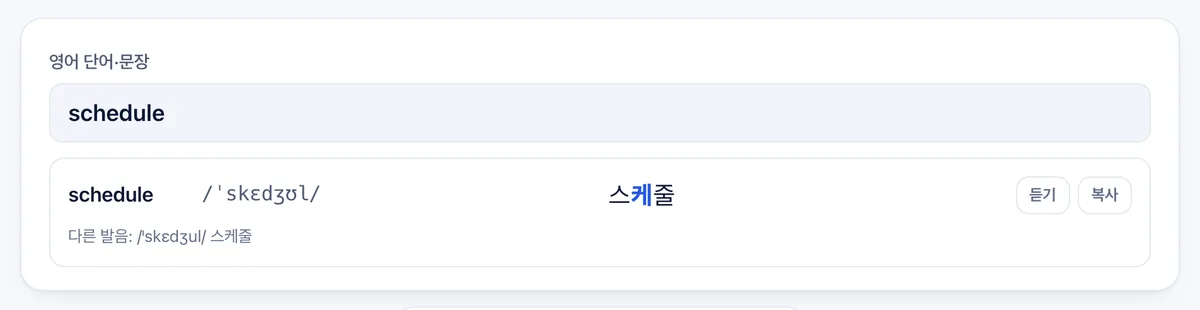
With the default input 'schedule,' the tool shows the IPA transcription /ˈskɛdʒʊl/ and the approximate Korean reading '스케줄.' An alternate pronunciation /ˈskɛdʒul/ is also listed. A listen button plays the word using a voice installed on the device.
Frequently asked
A word is missing?
Rare names and new slang may not be listed. Words ending in -s, -ed, -ing or -ly are guessed from their stem and marked as guesses.
British pronunciation?
The dictionary is American English, so transcriptions are US: rhotic r and the ɑ vowel in hot.
Is anything uploaded?
No. The dictionary files are fetched from this site and searched in your browser; nothing you type is sent or logged.